The Bomb Prevails - Baumgardner Wins Decision in Rough 10x3, Ennis vs. Zayas Undercard Announced, Skye Nicholson Calls for Undisputed, Big Baby Miller Throws 1000+ Punches in Pero Slugfest!


DQ w/ Damani had the privilege of attending Friday, April 17th’s MVP-02 card in New York City, complete with bouts featuring Alycia Baumgardner, Shadasia Green, and New York's very own Elon DeJesus.
The last time the news team was out for fight night was Gervonta "Tank" Davis and Lamont "The Reaper" Roach, an exciting card that took place at the Barclays Center.
This time around, the team traded Brooklyn for Manhattan, where the InfoSys Theater (previously Hulu Theater) at Madison Square Garden played host to a legendary night of fights on Most Valuable Promotions.
Baumgardner’s opposition was called into question several times across different media outlets, with many unsure of whether or not Bo Mi Re Shin could stand as a tall enough task for “The Bomb.”
However, what many forgot is that Shin shared the ring with Baumgardner’s close opposition, Caroline Dubois.
Dubois’ matchup with Shin took place on March 7th, 2025 and ended with a majority decision in favor of Dubois.
The two women battled for the WBC Lightweight World Championship, with Shin giving Dubois all she could handle.
Shin’s showing in the fight against Dubois was a pretty big indicator that she had strong punch durability and had no problem chasing her opponent on the front foot.
Despite all of the doubt, Shin approached both the Dubois and Baumgardner fights as a confident world title challenger who had earned her shot.
Baumgardner fielded plenty of questions on future matchups, but respected Shin’s ability and declined to overlook her.
That respect translated into a measured, disciplined performance once the bell rang.
Baumgardner, defending her unified junior lightweight crown, leaned on her experience early, establishing distance with a sharp jab and controlling the tempo rather than chasing an early stoppage.
Shin, true to form, pressed forward behind a high guard, attempting to close the gap and force exchanges where her physicality could come into play.
For long stretches the dynamic mirrored what was seen in Shin’s fight with Dubois.
She was willing to absorb shots to get inside, and she refused to be discouraged by Baumgardner’s cleaner work at range.
But where Dubois found herself in prolonged exchanges, Baumgardner was far more selective.
She picked her moments, stepping around Shin’s pressure and landing compact combinations before resetting in open space.
By the middle rounds, the difference in precision began to show.
Baumgardner’s right hand consistently split Shin’s guard, and her ability to pivot out of danger prevented Shin from sustaining meaningful offense.
Still, Shin’s durability held up under fire, reinforcing the reputation she had built in previous outings.
She continued to march forward, throwing in volume even when the shots lacked the same impact.
The later rounds became a test of control versus persistence.
Baumgardner, aware of the stakes as a four-belt unified champion, avoided unnecessary risks while continuing to bank rounds with cleaner, more effective punching.
Shin, meanwhile, maintained her pressure to the final bell, embodying the same resilience that earned her the title opportunity in the first place.
When the scorecards were read, the outcome reflected the fight’s rhythm, Baumgardner earning a clear decision victory to retain her unified world champion status at 130 pounds.
The performance may not have delivered a highlight-reel finish, but it reinforced her position as one of the most complete fighters in women’s boxing.
After the fight, Baumgardner again acknowledged the challenge Shin presented, emphasizing that the Korean contender’s toughness and forward pressure required discipline rather than recklessness.
Baumgardner offered massive praise to Shin for being such a willing dance partner in the ring with her, citing the fact that it takes two people to make a fight great.
It was a performance rooted in control, a champion’s approach to a fight where the margin for error was smaller than many anticipated.
For those in attendance, the fight offered a reminder of something often overlooked in pre-fight narratives.
Not every challenger arrives to fold under the lights.
Some come to test, to push, and to force champions into proving why they hold every belt in the division.
On this night at Madison Square Garden, Bo Mi Re Shin did exactly that.
[Ennis vs. Zayas Undercard Announced - Ben Whittaker's US Debut Officially Confirmed!]

The supporting cast for the June 27 showdown between Jarron Ennis and Xander Zayas at Barclays Center has taken shape, and it reflects a deliberate mix of rising prospects, regional draws, and stylistic clashes that could carry implications well beyond fight night.
At the center of the undercard is a compelling matchup between unbeaten prospect Emiliano Vargas and New York native Bryce Mills, a bout that blends momentum with local energy.
Vargas, the son of former champion Fernando Vargas and one of three Vargas brothers in the sport, has quickly developed a reputation as one of Top Rank’s most polished young fighters.
His rise has been marked by sharp fundamentals, disciplined aggression and a growing confidence that has translated into increasingly dominant performances.
While still early in his career, Vargas has shown an ability to control fights at range and finish exchanges with authority, making him one of the more intriguing prospects in the lower weight classes.
Mills, however, is not arriving to play the role of opponent.
Fighting out of Syracuse, he has built a strong following across upstate New York, regularly appearing on regional cards and drawing vocal support.
Known for his physical strength and willingness to engage, Mills presents a different kind of test, less about polish and more about grit.
The “home-state advantage” dynamic adds another layer, as the proximity to Brooklyn could tilt crowd energy in his favor.
For Vargas, it’s a step into a more hostile environment.
For Mills, it’s an opportunity to disrupt a rising prospect on a major stage.
Further down the card, Ben Whittaker will make his long-awaited United States debut, defending his WBC Silver Light-Heavyweight title against Richard Rivera.
Whittaker’s arrival stateside has been anticipated since the Olympic silver medalist turned professional, carrying with him a blend of showmanship and technical flair that has made him one of the sport’s most talked-about young fighters.
Whittaker leaked that he would be fighting on Boots' next undercard a few months ago, but very few knew that the card would be this big.
His style, hands low, reflexes sharp, often punctuated by moments of theatrical confidence, has drawn both admiration and skepticism.
Rivera, nicknamed “Popeye,” offers a grounded counterpoint.
He is best known for his 2022 bout against Badou Jack on the undercard of Joshua vs. Usyk II, where he delivered a gritty, competitive performance against a far more established opponent.
Rivera’s durability and willingness to press forward could test Whittaker’s composure, particularly if the British fighter is forced to move away from the stylistic freedom that has defined his early career.
For Whittaker, this fight is less about showcasing flair and more about proving he can handle a determined, experienced challenger under the scrutiny of a new audience.
Another bout carrying significant weight is the middleweight clash between Jahi Tucker and Euri Cedeno.
Tucker, known as much for his confidence outside the ring as his ability inside it, returns to familiar territory with the expectation of delivering a statement performance.
His style leans toward calculated aggression, mixing sharp combinations with an ability to dictate pace when he finds rhythm.
Cedeno represents a dangerous obstacle.
Entering unbeaten with a 14-0 record built heavily on knockouts, he brings a level of raw power that can alter a fight instantly.
Fighters with Cedeno’s profile often force opponents into uncomfortable decision, whether to engage and risk being caught or to retreat and concede control.
For Tucker, the challenge will be balancing his natural inclination to perform with the discipline required to neutralize a puncher.
The stakes extend beyond pride.
With three regional belts reportedly on the line, the winner is expected to move into the top 15 of the middleweight division, positioning themselves within reach of world-level opportunities.
In a division that remains fluid beneath its elite tier, that kind of movement can significantly alter a fighter’s trajectory.
Taken together, the undercard reflects a broader theme, calculated progression.
Each matchup places a rising name in a situation that demands more than just talent. Vargas must deal with a hostile environment.
Whittaker must prove substance behind style.
Tucker must navigate real danger against an unbeaten puncher.
All of it unfolds beneath a main event that already carries its own significance.
If the undercard delivers on its promise, June 27 won’t just be remembered for what happens at the top of the bill, but for the questions answered before the main event ever begins.
[Skye Nicholson Crushes Mariah Turner 100-89 - Calls for Undisputed Shot at Ellie Scotney!]

The fast-tracked rebuilding of Skye Nicolson is no longer a quiet process, it’s becoming a statement.
Inside Melbourne Pavilion, Nicolson delivered one of the most dominant performances of her career, outclassing fellow Australian Mariah Turner over 10 rounds en-route to a shutout decision victory.
The scorecards, 100-89 across the board, told a story that unfolded in real time.
Control, precision and a level of composure that never wavered were all a part of the painting Nicolson made in the ring.
It marked Nicolson’s fourth consecutive win since her upset loss to Tiara Brown 13 months ago, a defeat that forced a recalibration in both approach and mindset.
Since then, the 30-year-old has quietly rebuilt, refining the sharp counterpunching style that has long defined her while adding a more assertive edge to her offense.
Against Turner, that evolution was clear from the opening bell.
Nicolson established distance early, snapping her jab and dictating the pace with clean, efficient footwork.
Turner, game and willing, attempted to close the gap, but quickly found herself reacting rather than initiating.
By the second round, Nicolson’s southpaw left hand began to flow with more confidence, and by the third, the damage was visible, Turner’s nose bloodied, her face beginning to reflect the one-sided nature of the contest.
Round after round, Nicolson maintained that rhythm.
She worked behind her jab, pivoted off the center line and picked her moments to land sharper, more telling shots.
Turner’s toughness kept her in the fight, but it did little to slow Nicolson’s momentum.
In the corner, Nicolson remained calm and composed alongside her trainers, while Turner absorbed the accumulating effects of sustained, accurate punching.
The later rounds offered more of the same, with Nicolson mixing in lead hooks and quick combinations before resetting out of range.
Even when Turner found the occasional right hand, Nicolson remained a step ahead, answering back with cleaner, more effective work.
By the ninth, a crisp left-right combination rattled Turner once more, further widening the gap between them.
There was a brief moment of tension in the final round, with rough exchanges leading to Turner being docked a point for use of the head.
But even that did little to disrupt the flow of the fight.
Nicolson resumed control immediately, spearing Turner with a straight left and closing the bout as she had fought it, on her terms.
When the final bell rang, there was little suspense left.
Nicolson moved to 15-1 (3 KOs), defending her WBC Interim Junior-Featherweight World title in a performance that reinforced her standing as one of the sport’s most technically sound fighters.
Turner, who entered the fight at 12-1, left at 12-2, her durability and heart evident but ultimately outmatched by Nicolson’s precision.
Afterward, Nicolson made it clear that the victory was not just about winning, it was about growth and development.
“I knew she was going to be a tough, tough girl and she showed a lot of heart. We really worked on sitting down on my shots, being more spiteful and being more aggressive.”
But the conversation quickly shifted to what comes next.
Despite her status as one of the leading figures in women’s boxing, Nicolson has yet to secure the kind of defining superfight that cements a legacy.
Her loss to Brown remains the most notable name on her résumé, but opportunities at the highest level have been limited.
That changed the moment the scorecards were read.
With her interim status positioning her as a mandatory challenger, Nicolson set her sights on the division’s undisputed champion, Ellie Scotney, who currently holds all four major titles at 122 pounds.
“I want superfights, I want undisputed, I was born for the big stage.”
It was a direct and unapologetic call for the kind of fight that has so far eluded her.
“Ellie Scotney, I’m next in line, let’s make it happen. I know you’ve been at 122 for a long time, but come on, have one more fight.”
The timing adds intrigue.
Scotney recently defended her undisputed crown earlier this month on the undercard of Caroline Dubois vs. Terri Harper, but reports have suggested she may be considering a move up in weight.
If that move comes before facing Nicolson, the opportunity for a true undisputed clash could disappear before it materializes.
That possibility only adds urgency to Nicolson’s callout.
Promoter Eddie Hearn echoed that sentiment, acknowledging both the legitimacy of Nicolson’s position and the appeal of the matchup itself, noting that she is now the mandatory challenger and that a fight with Scotney represents one of the best available in women’s boxing.
For Nicolson, the message is simple.
The rebuilding phase is over.
The performances are no longer about proving she belongs, they are about demanding the fights that define careers.
After a shutout victory that left little doubt about her current form, she has made it clear exactly which fight she wants next.
[Jarrell Miller Earns Electrifying Unanimous Decision Win Over Lenier Pero, Advances to Potential Deontay Wilder Fight!]
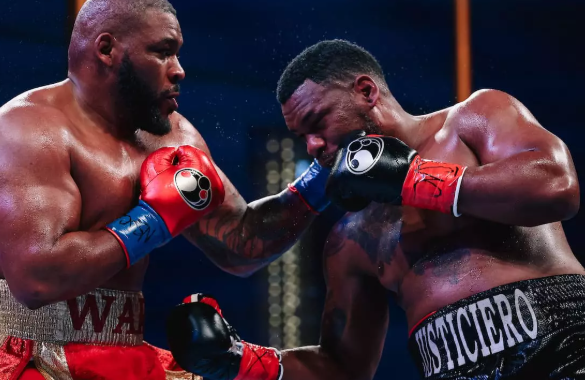
New hair, new problems.
Jarrell "Big Baby" Miller has been the internet's most viral boxer for the last three months, for all the wrong reasons.
Miller's last time out against Kingsley Ibeh was by no means his best performance, seeing as how he earned a split decision.
That fight on the undercard of Teofimo Lopez vs. Shakur Stevenson immortalized Miller in the sport.
Miller's hair nearly came flying off of his head in the second round of the contest, lifted up by an uppercut from Ibeh.
In a clip that has now been viewed over 3.1 million times on Instagram, Miller took the hair he had and threw it into the crowd, conveniently landing next to WBO Heavyweight World Champion Fabio Wardley.
For the rest of the 10 round fight, Miller embraced the moment and fought without his hair.
Now, three months on from the 97-93 split win over Ibeh, Miller had much to prove to the fans.
Lenier Pero, the undefeated Cuban standout managed by BoxLab Promotions, had every tool in the book to close the show on Miller.
As his next opponent, it was expected that the younger, fresher Pero with over 100 amateur fights would dominate Miller.
The fight was far from what pundits expected.
During the buildup, both men traded promises of knockouts, developing a picture of true bad blood.
For all of Pero's trash talk, Miller made him pay.
The early rounds featured Pero's intelligent boxing in full form.
Pero’s early success forced a reaction, and Jarrell Miller gave one once he realized he was potentially trailing in the fight.
Through the opening rounds, Lenier Pero found a rhythm that threatened to derail the night early.
He fired sweeping hooks and sharp uppercuts in the second, repeatedly catching Miller as the Brooklyn heavyweight looked to gauge distance.
Pero’s hand speed and cleaner punching gave him the edge at range, forcing Miller to abandon any thought of a measured approach.
By the third round, Miller made the adjustment that would define the fight.
He closed the distance, planted himself inside, and turned the bout into a grinding, physical battle along the ropes.
It was a deliberate shift, one that neutralized Pero’s jab and forced him into exchanges he could not fully control.
From there, the fight transformed into a war of attrition.
The two heavyweights traded at close quarters, but the numbers told the story of Miller’s approach.
He threw a staggering 1,003 punches over the course of the fight, landing 290 of them for a 29 percent connect rate.
Pero, while efficient, could not match that pace, landing 253 of 648 punches (39 percent) as he increasingly found himself reacting rather than dictating.
It wasn’t about precision for Miller.
It was about pressure.
“I knew Pero was going to be tough, but I expected him to move a lot more,” Miller said. “I wasn’t looking for the knockout. I wanted to see what my conditioning was like and get back to throwing a lot of punches.”
That conditioning became one of the night’s defining factors.
Miller entered the fight at 305 pounds, his lightest weight since 2018, and the difference was evident.
In recent outings, particularly against Daniel Dubois, Miller had struggled to maintain pace late.
This time, he sustained his pressure, continuing to push forward even as the rounds wore on.
By the sixth, Miller began to impose himself fully.
He ramped up the intensity, talking to Pero as he pressed him backward and unloading in tight spaces.
The constant physicality, leaning, mauling, and punching in bursts, gradually drained the Cuban contender’s effectiveness.
Pero remained game, continuing to throw and refusing to fold under the pressure. But the fight was slipping away.
Each round followed a similar pattern, with Miller advancing, working the body and head, forcing exchanges that favored his volume over Pero’s accuracy.
The second half of the fight became a test of endurance.
The Brooklyn native’s relentless output began to sap the energy from Pero, who could no longer maintain the same level of movement or punch variety that had troubled Miller early.
In the 10th round, Pero stood up from his stool and remained in his team's corner, too tired to gallop to the center of the ring to face Miller.
The exchanges grew heavier, more desperate, as both fighters dug in for a grueling finish.
By the championship rounds, it was a slugfest.
Both men traded in close, neither willing to give ground, but the cumulative effect of Miller’s pressure and activity had already shaped the outcome.
When the final bell rang, the judges rewarded his work rate and forward momentum, scoring the bout 117-111, 117-111, and 115-113 in his favor.
It was a statement win for "Big Baby", not just in result, but in approach.
The CompuBox numbers showed that Miller had thrown over 1,000 punches during the contest, proving that the weight cut increased his stamina, as well as his ability to remain consistent in form.
Afterward, Miller wasted little time turning his attention to what comes next, calling for a showdown with former WBC heavyweight champion Deontay Wilder.
The matchup, long discussed but never realized, immediately gained traction following the victory.
Promoter Eddie Hearn echoed that sentiment, pointing to the potential scale of the fight.
“The fight to make is Deontay Wilder against Jarrell Miller in New York,” Hearn said. “That’s a big, big fight for American heavyweight boxing.”
With Wilder coming off a split-decision win over Derek Chisora, the timing may finally align for a clash that has lingered in the background of the division for years.
For Miller, though, the takeaway from Saturday night in Las Vegas was clear.
He didn’t just win.
He proved he could go back to being the relentless, high-volume heavyweight that once made him one of the most difficult fights in the division.


Comments