Shakur Stevenson Thrashes Teofimo Lopez, Bruce Carrington Earns First World Title in Hometown Win, Jarrell Miller Wins By a Hair, William Scull Knocked Out!


The super-lightweight division has a new king.
Initially billed as a razor-thin super-lightweight showdown inside one of boxing’s most sacred venues instead became a unilateral demonstration of control, discipline, and defensive brilliance.
Under the bright lights of Madison Square Garden, Shakur Stevenson delivered a boxing masterclass, decisively outmaneuvering Teofimo Lopez over 12 rounds to capture the WBO Super-Lightweight World Championship along with The Ring Magazine and lineal 140-pound titles.
In a fight many expected to be split straight down the middle, largely due to Stevenson’s reputation for defensive movement versus Lopez’s explosive athleticism, Stevenson never allowed the bout to exist in that gray area.
From round one through round twelve, he authored a performance rooted in clarity and control, systematically stripping Lopez of his offensive identity and turning a highly anticipated chess match into a one-sided dissertation on elite ring generalship.
From the opening bell, Stevenson established dominance not with power, but with positioning.
His footwork immediately dictated the geography of the ring, circling just outside Lopez’s preferred range and resetting angles before danger could develop.
Stevenson’s jab functioned as a metronome, setting tempo while simultaneously disrupting Lopez’s timing.
Every exchange began and ended on Stevenson’s terms.
Lopez, a former unified lightweight champion known for capitalizing on mistakes, was given none.
Each attempt to step into range was met with sharp counters, subtle head movement, and immediate exits.
Stevenson’s defensive responsibility stood out most, he wasn’t simply avoiding punches, he was denying opportunities altogether.
Lopez swung with intent, but too often found air where Stevenson had been moments earlier.
As the fight progressed into the middle rounds, Lopez attempted to impose urgency, pressing forward in hopes of breaking Stevenson’s rhythm.
Instead, Stevenson leaned further into his strengths.
He welcomed pressure selectively, stepping inside just long enough to score cleanly before pivoting away.
The lateral movement, often criticized by detractors as excessive and boring, proved essential against a fighter as dangerous as Lopez.
This was not avoidance; it was control weaponized.
By the championship rounds, the pattern was unmistakable. Lopez stalked. Stevenson dictated.
Lopez searched for openings.
Stevenson closed them before they could form.
Power shots glanced off guard or missed entirely.
Combinations never materialized. Frustration crept in as Stevenson’s composure remained unshaken, his precision unchanged.
What elevated the performance from impressive to elite was Stevenson’s consistency. There were no mental lapses, no unnecessary risks, no rounds surrendered through complacency.
Across all twelve rounds, he executed the same disciplined game plan with unwavering focus, reinforcing the sense that this was not a hot streak, but a fully realized evolution.
When the final bell sounded at Madison Square Garden, the conclusion felt inevitable.
Stevenson had not merely beaten Teofimo Lopez, he had shut him down, claiming the WBO belt and The Ring/lineal championship without the need for knockdowns or dramatics.
This was dominance through denial, the highest form of boxing control.
With the victory, Shakur Stevenson becomes a world champion in a fourth weight division, adding the super-lightweight crown to his résumé while maintaining his unblemished professional record.
In doing so, he joins Gary Antuanne Russell, Richardson Hitchins, and Dalton Smith as reigning champions at 140 pounds, elite company in one of boxing’s deepest divisions.
For Lopez, the defeat marks the second loss of his career, a sobering setback for a fighter accustomed to dictating narratives.
While his toughness and persistence were evident, the answers never came. Adjustments will be necessary moving forward, but his talent remains undeniable.
For Stevenson, this was a defining statement.
Long criticized by some fans for prioritizing defense over spectacle, he delivered the ultimate rebuttal.
Against one of the sport’s most dangerous and accomplished fighters, his style was not only effective, it was required.
Boxing at its highest level is about control. On this night at Madison Square Garden, Shakur Stevenson didn’t just control the fight, he owned it.
[Bruce Carrington Snatches WBC Featherweight Title in Hometown Win!]
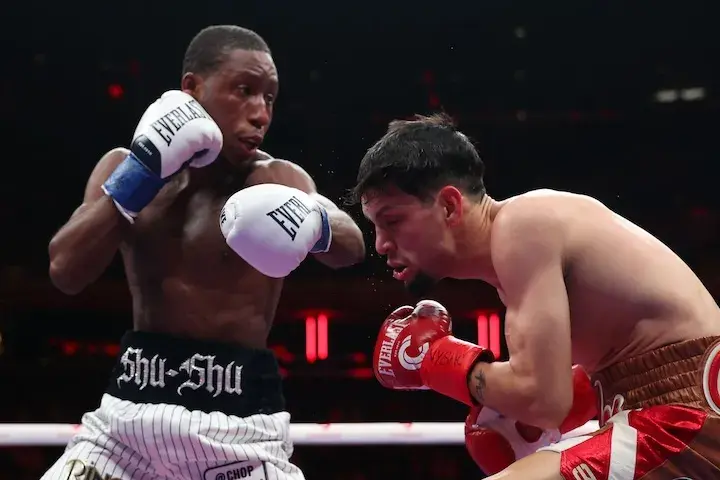
On a night already destined for significance at Madison Square Garden, Bruce “Shu Shu” Carrington ensured that the event would not be remembered solely for Shakur Stevenson’s technical brilliance.
Fighting on the undercard of Stevenson vs. Teofimo Lopez, Carrington delivered a performance that was as emotionally resonant as it was violently decisive, capturing his first world championship in front of a hometown crowd and announcing himself as a true force in the featherweight division.
For Carrington, this was more than a title fight. It was a culmination.
A Brooklyn fighter competing on boxing’s most historic stage, with a world title at stake, in a building where careers are either elevated or exposed.
Now, more than ever, "Shu York City" had to be in full effect.
The stakes were enormous, and the opponent ensured there would be no shortcuts. Across the ring stood Carlos Castro, a battle-tested contender whose résumé carried real weight.
Castro had previously shared the ring with Stephen Fulton, and notably dropped Fulton during their encounter, an achievement that underscored both his power and his credibility at the elite level.
For a young champion-in-the-making like Carrington, this was not a developmental fight. This was a proving ground.
The tone was set immediately.
From the opening bell, both men wasted no time asserting themselves.
The first round erupted into exchanges almost instantly, with Carrington meeting Castro’s aggression head-on.
Castro came to fight, pressing forward and throwing with intent, clearly intent on testing the young contender’s resolve early.
Carrington responded in kind, standing his ground, trading blows, and showing that he was not intimidated by either the moment or the man in front of him.
The pace was fast, the contact heavy, and the message clear, this was going to be a fight earned the hard way.
As the bout progressed, the layers of Carrington’s game began to separate him.
While Castro relied on pressure and physicality, Carrington blended sharp fundamentals with composure beyond his years.
His jab created openings. His shot selection became more deliberate.
Most importantly, he showed the ability to absorb moments of danger without unraveling.
This was where the significance of Castro’s pedigree truly came into play.
This was, without question, the most difficult test of Carrington’s young career, an opponent capable of hurting elite fighters and forcing uncomfortable exchanges.
Yet, as the rounds wore on, Carrington’s control grew. He began to time Castro’s entries, meeting forward movement with clean counters and subtly taking steam off the veteran’s attacks.
The exchanges that were once even began to tilt. Carrington wasn’t just surviving the fire anymore, he was shaping it.
Then came the defining moment in the ninth round.
When Carrington finally found the opening, he did not hesitate.
A perfectly timed sequence detonated on Castro, sending him crashing to the canvas in devastating fashion.
Castro’s body went limp as he fell, frozen where he landed, leaving no doubt about the finality of the outcome. The referee’s intervention was immediate and necessary.
Madison Square Garden fell into a stunned roar as the realization set in.
Bruce “Shu Shu” Carrington was a world champion.
The emotional release was instant.
Carrington, overcome by the magnitude of the moment, broke down in tears inside the ring.
This was not manufactured celebration or performative bravado.
This was the visible weight of years of work, sacrifice, and belief finally paying off, at home, on the biggest stage, with the ultimate prize, the big green WBC belt now his own.
In a sport often defined by bravado, Carrington’s raw emotion cut through everything.
The victory resonated beyond the knockout itself.
Beating Carlos Castro so emphatically did more than earn Carrington a title, it answered questions. Could he handle pressure? Yes.
Could he withstand adversity? Yes.
Could he finish a dangerous, experienced opponent when it mattered most?
Undeniably so.
Where others had struggled or been tested deep into fights with Castro, Carrington ended matters with authority.
In the broader context of the night, Carrington’s triumph fit seamlessly into the narrative unfolding at Madison Square Garden.
Stevenson’s masterclass headlined the card, but Carrington’s breakthrough gave the event its heart.
It was a reminder that while championships can be won with finesse and control, they can also be seized through grit, courage, and a moment of perfectly executed violence.
Now, as the newly crowned WBC Featherweight World Champion, Carrington steps into an entirely different reality.
The division opens up. Expectations rise.
Targets appear on his back.
But if this night was any indication, Bruce “Shu Shu” Carrington is not just ready for the responsibility, he’s prepared to thrive under it.
Madison Square Garden has always been a place where fighters become something more than contenders.
On this night, amid tears, cheers, and a fallen opponent on the canvas, Bruce Carrington became a world champion, and did it in unforgettable fashion.
[Jarrell Miller Wins By a Hair - Bests Ibeh in Unexpected Comedic Clash!]

On the undercard of the Shakur Stevenson vs. Teofimo Lopez super-lightweight blockbuster at Madison Square Garden, one of the fight week’s most viral moments didn’t come from Stevenson’s championship mastery or Bruce “Shu Shu” Carrington’s emotional world title rise, it came from a bizarre, unforgettable exchange in the heavyweight bout between Jarrell “Big Baby” Miller and Kingsley Ibeh that immediately dominated social media and boxing conversation.
From the opening round, Miller and Ibeh locked into a competitive heavyweight affair.
Both men traded in close, Miller pressing forward with his trademark physicality while Ibeh looked to land clean shots and establish range.
The fight was competitive, the type of 10-round heavyweight grind that rewards strength, resilience, and opportunism, but what happened early shifted attention from the competitive to the surreal.
As Ibeh landed a clean uppercut and followed up, Miller’s hairpiece popped clean off his head, flying upward under the Garden lights in a moment so unexpected it took the crowd a second to even process what they had seen.
Cameras caught everything.
Within minutes, the clip was everywhere, sports timelines, meme pages, and mainstream outlets replaying the moment from every angle.
What could have easily unraveled a fighter instead became a defining visual of the night.
Miller finished the round unfazed, then between rounds removed the hairpiece entirely and tossed it into the crowd, leaning directly into the absurdity rather than allowing it to distract him.
WBO Heavyweight Champion Fabio Wardley and Skye Nicholson, both featured earlier in the evening on the DAZN broadcast, collected Miller's hairpiece as a token of the surreal moment.
Nicholson even posed with the hair atop her head, which went viral almost immediately after the initial posts about Miller's sudden baldness had stormed the internet.
After the fight, Miller addressed the moment with humor, fully aware of how quickly it had taken on a life of its own.
“I’m a comedian, man. You gotta laugh at yourself sometimes,” Miller said afterward. “Stuff happens. It’s boxing.”
That ability to shrug off chaos mirrored the rest of his performance in the ring.
Once the viral moment faded, the fight itself revealed a familiar version of Jarrell Miller, tough, durable, and still dangerous, but clearly operating within known limits.
His showing was not indicative of a fighter ready for a world title challenge.
Still, on any given night against most of the heavyweight division, Miller remains a problem.
Against the true elite, however, the gap remains evident.
Miller’s long-standing issues with conditioning and weight again shaped the fight’s trajectory.
Early on, he stayed active with uppercuts and hooks to the body, slowly wearing on Ibeh and forcing him to walk back his offense.
Those shots mattered.
Ibeh’s output dipped, and the physical toll became apparent as the rounds wore on.
But just as Ibeh began to slow, so did Miller.
His gas tank, a recurring theme throughout his career, once again betrayed him.
By the time Miller had Ibeh near a potential finish, his own stamina had faded enough to prevent him from capitalizing fully.
The bout drifted away from structure and into attrition, devolving into a sloppy slugfest across the later rounds rather than a clean closing statement.
Miller ultimately did enough to secure the victory on the scorecards, snapping a stretch without a definitive win and keeping himself relevant in a crowded heavyweight landscape.
Still, the result reinforced a familiar truth.
Even an exhausted Miller is a dangerous fighter, but the version of him that might have existed with consistent preparation and full camps remains a lingering “what if.”
In the broader context of the night, Miller’s bout added chaos and unpredictability to a card otherwise defined by precision and emotion.
Stevenson delivered control.
Carrington delivered catharsis.
Miller delivered spectacle.
He left Madison Square Garden with his hand raised, his hairpiece gone, and the internet firmly in his grasp, still competitive, still flawed, and still one of boxing’s most uniquely compelling heavyweights, even when the spotlight finds him in the most unexpected way.
[William Scull Knocked Out by Jacob Bank, Elite Status In Doubt!]

William Scull was on the receiving end of one of the most devastating finishes to open up the year.
The final chapter of the week unfolded with a result that felt as shocking as it was deflating.
In a division overflowing with opportunity, William Scull’s latest setback may prove to be the most damaging of his career, as Jacob Bank stopped him in the 12th round after what can only be described as a puzzling, self-sabotaging performance.
On paper, the matchup represented a clear pathway forward for Scull at super-middleweight, a division currently flush with belts, contenders, and maneuverability for anyone capable of stringing together a meaningful run.
Instead, the night ended with Scull staring at the ceiling, his latest world-title ambitions slipping away in real time.
From the opening bell, something felt off.
Rather than asserting himself behind a tight guard and disciplined pressure, Scull elected to box almost the entire fight with his hands unusually low, often leaving his head exposed or relying on reflexes rather than structure.
At times it resembled a loose guard; at others, no guard at all.
Whether it was overconfidence, a misread of Bank’s abilities, or a tactical gamble gone wrong, the approach never adjusted, and Bank noticed immediately.
Jacob Bank didn’t need to reinvent himself to capitalize.
He simply stayed disciplined.
His jab became the fight’s defining weapon, repeatedly finding Scull’s face with alarming consistency across all twelve rounds.
It wasn’t flashy, but it was effective.
Time and again, Scull attempted to counter or bait Bank into mistakes, but the jab beat him to the spot, disrupting rhythm and preventing any sustained momentum.
As the rounds wore on, the disparity in control became clearer.
Scull was active, but not effective. Bank was patient, measured, and increasingly confident.
What made the performance from Scull so troubling was not just that he was losing rounds, it was that he appeared unwilling or unable to correct the flaw that was costing him the fight.
The low hands remained.
The jab kept landing.
The warning signs piled up.
By the championship rounds, the fight had become a slow march toward consequence.
Bank, having banked rounds and reads, finally pressed his advantage with intent.
In the 12th, he found Scull clean with a sharp jab followed immediately by a straight cross, a textbook sequence that landed flush and sent Scull crashing to the canvas.
It was not a lucky punch or a moment of chaos, it was the inevitable conclusion of twelve rounds of positioning and patience.
Scull rose and beat the count, but the damage was evident.
His legs betrayed him. His posture sagged.
The referee, recognizing what Scull himself could not, waved the fight off. Just like that, another potential title run evaporated.
The stoppage may spark debate, but the broader truth is unavoidable.
Scull put himself in danger long before the final bell.
Boxing at this level offers little margin for mystery or stubbornness, and the decision to fight with a loose, low guard against a disciplined jabber proved disastrous.
Against elite competition, habits are punished, and Bank punished every one of them.
The loss lands especially hard given the current state of the super-middleweight division.
With belts scattered, potential unifications looming for vacant title winners, and contenders cycling in and out of relevance, this is arguably the most fertile moment in years for a fighter to break through.
For Scull, this bout was supposed to keep him in that conversation.
Instead, it removed him from it entirely, at least for the foreseeable future.
Jacob Bank, meanwhile, exits the night with a career-defining victory.
Ranked fourth by The Ring, Bank has the potential to cause major upsets against the big steppers of the division, like he did against Scull.
He didn’t overwhelm Scull with power. He didn’t rely on chaos.
He simply executed, round after round, until the opening was undeniable, and when it came, he closed without hesitation.
For William Scull, the questions are heavier than the loss itself. Why the low guard? Why no adjustment?
Why allow the same punch to dictate twelve rounds?
At this stage of a career, those questions are not philosophical, they’re existential.
In a division that rewards precision, discipline, and adaptability, Scull offered none when it mattered most.
In a super-middleweight landscape overflowing with gold, that may be the costliest mistake of all.


Comments