Raymond Muratalla Cruises Past Cruz, William Scull Returns In Sweden, Khalil Coe Delivers Attitude Adjustment, Deontay Wilder Returning Against Chisora, UFC 324 Weight Cut Horrors!

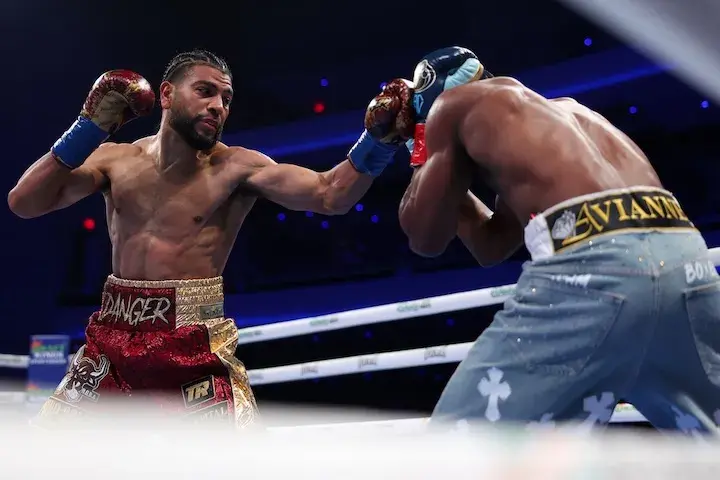
Raymond Muratalla retained his IBF lightweight world championship Saturday night, earning a narrow and contentious decision over Olympic gold medalist Andy Cruz in a 12-round title fight that capped a crowded weekend of boxing and reignited debate over judging at the sport’s highest level.
Muratalla was awarded a majority decision after one judge scored the bout even, while the other two sided with the defending champion, allowing him to keep the belt in what was widely viewed as one of the closest fights of his career.
While the official verdict secured Muratalla’s position atop the IBF’s 135-pound division, the result immediately split opinion throughout the boxing world, with many believing Cruz had done enough to capture his first professional world title.
From the opening bell, the contest unfolded as a technical duel rather than a slugfest.
Cruz, undefeated entering the bout and widely regarded as one of the sport’s most polished technicians, relied on precise footwork, sharp counters, and distance control to neutralize Muratalla’s pressure.
Muratalla responded by steadily advancing behind a high guard, attempting to close the gap and force exchanges with the challenger.
The contrast in styles defined much of the fight.
Cruz often appeared to land the cleaner punches, darting in and out with quick combinations and slipping away before Muratalla could fully respond.
Muratalla, however, remained composed and persistent, investing in body work and throwing in higher volume during prolonged exchanges, particularly when he was able to back Cruz toward the ropes.
Rounds were difficult to score with clarity as momentum shifted subtly throughout the contest. Cruz seemed to control large portions of the fight with accuracy and composure, while Muratalla’s pressure and activity proved effective in close rounds.
Neither fighter produced a definitive moment that clearly separated the bout, and the championship rounds mirrored the rest of the fight, competitive, tactical, and tightly contested.
When the scorecards were announced, the mixed reaction inside the arena reflected the uncertainty surrounding the decision.
Cruz briefly raised his arms, believing he had done enough, while Muratalla waited anxiously before learning he would retain his title.
The margins on the cards quickly became a focal point of discussion among fans and analysts.
Online reaction was swift and polarized.
Many observers labeled the decision a robbery, pointing to Cruz’s cleaner work and ring control.
Others defended the verdict, arguing that Muratalla’s pressure, body shots, and willingness to engage consistently earned him enough rounds to justify the decision.
Muratalla’s supporters contended that the champion effectively “boxed along” with Cruz rather than being outmatched, matching his rhythm and doing just enough to edge the close rounds.
In that view, Muratalla’s ability to remain competitive against a fighter of Cruz’s pedigree underscored why the fight was always destined to be difficult to judge.
Cruz, visibly disappointed but composed afterward, offered a candid assessment of the outcome.
“To be honest, I always feel like I can do more. Tonight, to be totally honest, I feel that I did do enough, and deserved the victory. No, to be honest, I always said it wasn't going to be an easy fight. Today he beat me. I don't have more to say.”
The loss marked the first of Cruz’s professional career, but it did little to diminish his standing in the lightweight division.
The former amateur standout demonstrated that his elite-level skills translate to the professional ranks, even in defeat.
Muratalla, now firmly established as a world champion, acknowledged the difficulty of the contest and credited Cruz for pushing him to his limits.
The victory strengthens Muratalla’s résumé but also raises questions about what comes next, with calls already emerging for a rematch or higher-profile bouts within a stacked lightweight division.
The fight served as a fitting conclusion to a weekend filled with high-stakes matchups, razor-thin decisions, and renewed scrutiny of boxing’s scoring system.
While Muratalla leaves Las Vegas with the IBF title still around his waist, the debate surrounding the result ensures the bout will be discussed long after the final bell.
In a sport often defined by interpretation as much as impact, Saturday night’s clash between Muratalla and Cruz offered a reminder of both boxing’s brilliance, and its enduring controversies.
[William Scull Set For in Ring Return Against Jacob Bank!]

The WBO Super-Middleweight rankings paint an interesting picture of how the shape of the division is changing.
With the retirement of Terence Crawford, Saul "Canelo" Alvarez tops the list.
The void of left by Crawford's absence means that there's no champion, and the chase is on to determine who will get a shot at the full WBO belt.
Diego Pacheco occupies number two, while Hamzah Sheeraz rests at three.
In the fourth spot is an interesting name, and one very few American feens have been keen to watch.
Jacob Bank of Kolding, Denmark has had a relatively tame career, led along with the right opposition for a fighter of his age.
Beginning his career in Denmark’s regional circuit, Bank has steadily built an undefeated record while avoiding the kind of reckless matchmaking that can derail young prospects before they mature.
Now (record undisputed and unblemished), Bank enters his most consequential assignment to date when he faces William Scull on January 31 at Sydbank Arena in Sweden, a bout that represents a clear step up from regional relevance to international scrutiny.
For Bank, the fight is both opportunity and risk. Fighting in Scandinavia, though not quite home territory, provides a familiar atmosphere and a supportive crowd, but the challenge across the ring is unlike anything he has previously faced.
Scull, a Cuban-born contender who has quietly positioned himself as one of the division’s most technically sound operators, represents a level of experience and composure that cannot be replicated on the regional scene.
Scull has long been regarded by insiders as a fighter whose résumé does not yet reflect his ability.
A product of Cuba’s storied amateur system, Scull brings a disciplined, methodical style rooted in footwork, timing, and ring IQ.
He has made a career of dismantling opponents without unnecessary risk, frustrating aggressive fighters and neutralizing punchers through control and patience.
That approach has allowed him to climb the rankings while remaining largely under the radar of casual fans.
The stakes of the bout extend beyond personal pride. With the WBO super-middleweight landscape in flux following Terence Crawford’s retirement, the division has entered a period of reordering.
Saul “Canelo” Alvarez sits atop the rankings, but without a reigning WBO champion, contenders are jockeying for position in what has become a wide-open chase for the full belt.
Diego Pacheco and Hamzah Sheeraz have emerged as prominent names near the top, but the middle of the rankings is crowded with fighters eager to capitalize on a single defining victory.
That context makes Scull’s trip to Sweden particularly significant.
A convincing win over an undefeated regional champion on foreign soil would strengthen his case as a legitimate threat in the title conversation and further separate him from the pack of contenders still searching for a breakout moment.
For Bank, the bout offers a fast-track opportunity to leap from relative obscurity into the global rankings, provided he can solve the puzzle Scull presents.
Stylistically, the matchup promises tension more than chaos.
Bank has shown a willingness to press forward behind a solid guard, using physicality and persistence to wear down opponents.
Scull, by contrast, thrives in fights where opponents grow impatient, capitalizing on mistakes with sharp counters and disciplined defense.
The bout may hinge on whether Bank can impose his will early or whether Scull’s experience and composure gradually take control as the rounds progress.
Fighting in Sydbank Arena adds another layer of intrigue.
Sweden has become an increasingly active hub for European boxing, and the setting provides a neutral-but-energized backdrop for a fight that could alter the trajectory of both careers.
For Scull, it is another test of adaptability, performing under unfamiliar conditions against a hungry, undefeated opponent.
For Bank, it is the chance to prove that his careful development has prepared him for the next level.
As the super-middleweight division continues to reshape itself, fights like Scull vs. Bank serve as quiet but crucial inflection points. While the spotlight often remains fixed on established stars, it is bouts like this, fought far from Las Vegas or New York, that determine who truly belongs in the championship conversation.
On January 31, William Scull and Jacob Bank will step into the ring with more than rankings at stake. One man will leave Sweden with momentum and legitimacy in a rapidly evolving division. The other will be left to reassess where the climb truly begins.
[Khalil Coe Scrapes To The Finish Line Against Jesse Hart!]

Khalil Coe emerged with a hard-fought and controversial victory over veteran Jesse Hart on Saturday night, edging a decision in a bout that was as punishing and disorderly as it was prolonged, defined less by clean action than by persistent fouling, clinching, and mounting frustration from both corners.
From the opening rounds, the fight showed little resemblance to a conventional light heavyweight contest.
Hart, the more experienced of the two and a former world-title challenger, repeatedly tied Coe up at close range, smothering offense and slowing the tempo.
Coe, younger and physically larger on fight night, attempted to force separation with aggression, but was frequently pulled into extended holds that left the action disjointed and the crowd restless.
As the rounds wore on, the bout grew increasingly physical and tense.
Referee warnings accumulated with little effect, and the lack of consistent enforcement allowed the fight’s rough edges to define it. Clean combinations were rare.
Instead, both fighters resorted to short, scornful shots inside, forearms, clubbing hooks, and punches thrown more out of irritation than strategy.
The moment that came to symbolize the contest arrived midway through the fight, when Coe, visibly exasperated by Hart’s persistent clinching, hoisted the veteran off his feet and slammed him to the canvas.
The act drew immediate outrage from Hart’s corner and a stern reprimand from the referee, but no point deduction followed, a decision that further fueled controversy surrounding the bout’s officiating.
Coe’s frustration was understandable, but his discipline wavered as the fight dragged on.
Hart, 33, leaned on every ounce of his veteran savvy, bending the rules to disrupt Coe’s rhythm and force him into uncomfortable exchanges.
The tactic echoed the survival instincts Hart developed through championship-level competition, including previous bouts against Joe Smith Jr. and Gilberto “Zurdo” Ramirez, where durability and experience were central to his success.
The narrative surrounding the fight was further complicated before the opening bell.
Coe missed weight by a staggering eight pounds, an egregious overage that immediately raised questions about preparation, professionalism, and intent.
Critics were quick to suggest the miss reflected apprehension about facing a seasoned opponent like Hart, framing the bout as one Coe sought to tilt physically in his favor.
Inside the ring, Coe did little to dispel those perceptions.
Though he controlled stretches of the fight with raw strength and sporadic power shots, he struggled to impose sustained dominance.
Hart’s holding neutralized much of Coe’s offense, while Coe’s impatience cost him opportunities to separate cleanly and score decisively.
Still, when the fight opened up, briefly and infrequently, Coe landed the heavier blows.
His power shots, though isolated, appeared to register more clearly than Hart’s shorter counters, and those moments ultimately proved decisive in the eyes of the judges.
Hart, for his part, showed flashes of the grit that carried him through past wars.
He absorbed punishment, stayed competitive deep into the fight, and continued to antagonize Coe both physically and verbally, trading words as often as punches.
The animosity between the two fighters simmered throughout, with neither showing interest in backing down despite the fight’s increasingly ugly character.
By the final rounds, the bout had become a test of endurance and will rather than skill. Both men looked spent, yet neither relented.
The fouling persisted, the holding remained unchecked, and the sense that the fight could continue indefinitely hung over the arena.
When the final bell sounded, there was little clarity but no shortage of opinion.
The judges ultimately awarded Coe a narrow decision, a verdict that reflected the thin margins and murky nature of the contest.
While Coe edged the victory, the performance raised as many questions as it answered.
For Coe, the win preserves momentum but does little to silence doubts.
The weight miss, the lack of composure, and the inability to decisively separate himself from a veteran opponent will invite scrutiny as he looks to climb the light heavyweight ranks.
For Hart, the loss adds another chapter to a career defined by resilience and toughness.
Though past his championship peak, he once again demonstrated why he remains a difficult assignment, awkward, experienced, and willing to drag opponents into uncomfortable territory.
The fight served as a reminder that not all wins are clean, and not all losses are definitive.
In a weekend full of boxing, Coe and Hart delivered one of the ugliest bouts, and one of the most revealing, exposing both the strengths and limitations of each man long after the decision was rendered.
[Deontay Wilder vs. Derek Chisora Close to Finalization for April!]

Deontay Wilder and Derek Chisora are close to finalizing a deal for an April heavyweight bout that, if completed, would pair two of the division’s most recognizable veterans at a moment when timing and circumstance align for both men.
Multiple reports in the United Kingdom and United States indicate negotiations are in the advanced stages, with both camps viewing the fight as a rare intersection of legacy, marketability, and practicality.
For Chisora, the bout represents far more than another paycheck.
The 41-year-old British heavyweight has made no secret of his intention to end his career on his 50th professional fight, and a showdown with Wilder would provide a definitive closing chapter to one of the most durable and unconventional careers of the modern heavyweight era.
Chisora has built his reputation on relentlessness and availability, repeatedly stepping in with elite opposition regardless of risk, and a final fight against a former world champion would offer a fitting summation of a career defined by toughness rather than titles.
Chisora’s résumé underscores that reputation.
Over nearly two decades as a professional, he has faced a who’s who of heavyweight boxing, including Tyson Fury, Oleksandr Usyk, Joseph Parker, Dillian Whyte, Joe Joyce, and Otto Wallin.
He challenged for a world title early in his career and later reinvented himself as a gatekeeper capable of testing contenders and champions alike.
Even in defeat, Chisora’s fights have often been compelling, physically demanding affairs, earning him respect across the sport and sustained relevance well beyond his championship window.
Wilder, meanwhile, arrives at this potential matchup from a different but equally pivotal place in his career.
A former WBC heavyweight champion, Wilder remains one of the most recognizable figures in boxing, his name inseparable from an era defined by dramatic knockouts and high-stakes rivalries.
Though recent years have brought setbacks, his standing in the sport is secure, anchored by a historic trilogy with Tyson Fury that will remain etched in boxing history for its brutality, drama, and significance in shaping the modern heavyweight landscape.
That trilogy, contested between 2018 and 2021, elevated both men and delivered some of the most memorable moments of the last generation, including knockdowns that redefined heavyweight spectacle.
While Wilder ultimately fell short in those encounters, the series cemented his reputation as one of the division’s most dangerous punchers and ensured his continued drawing power even outside the title picture.
Few heavyweights, active or retired, carry a résumé that commands immediate attention in the way Wilder’s does.
At this stage of their careers, the matchup makes sense on several levels.
For Chisora, it offers the chance to conclude his career against a globally recognized opponent rather than fading quietly.
For Wilder, it provides an opportunity to remain relevant in a crowded heavyweight field while facing a name that still resonates with fans on both sides of the Atlantic.
The fight also avoids the pitfalls of premature retirement bouts or mismatched tune-ups, instead delivering a pairing that feels earned through longevity and shared experience at the top level.
Critically, the bout carries narrative weight without the burden of championship stakes.
Chisora’s quest to reach fight number 50 gives the event emotional gravity, while Wilder’s status as a former champion ensures the fight will be viewed as meaningful rather than symbolic.
It is a contest shaped by careers nearing their final chapters, not defined by what either man was at his peak, but by what they still represent to the sport.
If finalized, the fight would also reflect a broader trend in heavyweight boxing, where veteran names continue to anchor major events even as a new generation emerges.
Wilder’s presence still guarantees attention, and Chisora’s fan-friendly reputation in the United Kingdom makes him a reliable draw, particularly for a farewell bout.
Promoters and broadcasters are keenly aware of that dynamic, and it has fueled optimism that the deal will be completed.
While questions remain about what the fight means competitively, there is little debate about its significance symbolically.
Chisora’s career, marked by resilience and reinvention, would reach its intended conclusion, while Wilder would add another notable chapter to a legacy already defined by extremes.
In a division where timing often dictates opportunity, an April meeting between Wilder and Chisora feels less like coincidence and more like inevitability, a fight arriving precisely when both men need it to.
[Cameron Faints in UFC 324 Weight Cut Horror!]

Weight cutting has long been accepted as an unavoidable reality in combat sports, a test of discipline and sacrifice that separates fighters by divisions and, in theory, ensures fairness.
But scenes from UFC 324, particularly the frightening collapse of bantamweight Cameron Smotherman, have once again exposed the practice as one of the most dangerous and poorly controlled aspects of modern mixed martial arts, raising renewed questions about how much risk the sport is willing to tolerate in pursuit of competitive balance.
Smotherman, a 5-foot-9 fighter from Houston, Texas, was scheduled to compete in the bantamweight division on UFC’s historic first event broadcast on Paramount Plus.
As he stepped onto the scale to attempt to make the 135-pound limit, he appeared visibly drained, his face drawn and his posture unsteady.
Moments after completing his weigh-in, Smotherman walked to the right, stumbled, and then collapsed face-first onto the stage.
His body went limp on impact before beginning to twitch and seize.
UFC staff immediately rushed to his side, rolling him over and calling for medical assistance as the weigh-in abruptly halted.
Smotherman was transported to a hospital and later ruled out of his fight, which was canceled.
The incident unfolded in real time, in front of cameras and spectators, and left little room for speculation about the toll his weight cut had taken.
While fighters routinely endure exhaustion at weigh-ins, the severity of Smotherman’s collapse underscored how narrow the margin can be between discomfort and medical emergency.
For many observers, his height and frame only intensified the concern, with critics arguing that a 5-foot-9 athlete attempting to reach 135 pounds is likely forcing his body into a state it was never meant to sustain, and that Smotherman may be a natural featherweight rather than a bantamweight.
The science behind weight cutting helps explain why such moments occur.
Fighters typically reduce large amounts of weight in a short period through extreme dehydration, calorie restriction, and heat exposure.
Medical studies have repeatedly shown that rapid dehydration can disrupt electrolyte balance, thicken the blood, impair kidney function, and increase the risk of neurological events such as fainting or seizures.
In severe cases, the stress placed on the body can result in rhabdomyolysis, acute kidney failure, or collapse, particularly when dehydration is combined with physical exertion and heat.
Smotherman’s collapse was not the only troubling weigh-in moment associated with UFC 324.
Former flyweight champion Deiveson Figueiredo also struggled badly on the scale, missing weight after two attempts.
While missing weight is not uncommon in MMA, Figueiredo’s physical appearance alarmed many fans and analysts.
His frame appeared gaunt and depleted, with little visible body fat remaining to lose, prompting questions about how much further his body could be pushed.
What made the situation more concerning was that Figueiredo had already moved up from the 125-pound flyweight division, a change widely viewed as necessary after years of brutal weight cuts at the lower limit.
The expectation was that the move to a higher weight class would alleviate the strain.
Instead, Figueiredo’s appearance suggested that the culture of cutting weight had followed him upward.
The implication was difficult to ignore, when fighters change divisions, the pressure to gain a perceived size advantage on fight night often encourages them to continue cutting to extremes, regardless of the long-term consequences.
These incidents are not anomalies but part of a broader pattern in combat sports.
One of the most infamous examples remains former UFC bantamweight champion T.J. Dillashaw, who admitted to using the banned substance EPO while attempting to make the 125-pound limit for a title fight.
Dillashaw’s skeletal appearance at the weigh-in shocked observers, and his subsequent performance inside the cage was widely viewed as evidence that the cut had severely compromised him.
The episode not only resulted in a suspension but also became a cautionary tale about how far fighters may go when weight cuts push the body past its natural limits.
Despite growing awareness of the risks, the incentives to cut weight remain deeply embedded.
Fighters believe that entering the cage heavier than their opponent provides a strength and durability advantage, while coaches and camps often treat extreme cuts as standard preparation.
Promotions, meanwhile, benefit from a system that allows fighters to compete in familiar divisions without fundamentally altering long-standing structures.
Efforts to mitigate the dangers have been uneven.
Some athletic commissions have experimented with hydration testing, additional weigh-ins, or limits on the amount of weight fighters can regain between weigh-in and fight night.
Yet enforcement varies widely, and many measures rely on fighters self-reporting or complying in good faith.
As incidents like Smotherman’s collapse demonstrate, even fighters who technically make weight can arrive at that number in a state of serious physiological distress.
What made UFC 324 particularly jarring was its visibility.
Smotherman’s collapse was not a private medical incident or a post-event disclosure, it happened on stage, in front of an audience, as part of a marquee broadcast.
Figueiredo’s gaunt appearance similarly played out under bright lights, impossible to dismiss as routine.
Together, the moments forced viewers to confront the reality that the weigh-in process itself can be more dangerous than the fight.
As mixed martial arts continues to grow and expand to new platforms and audiences, the question of weight cutting looms larger.
The sport has made strides in athlete safety inside the cage, from improved gloves to stricter concussion protocols.
Yet outside the cage, in the hours and days before competition, fighters are still pushing their bodies to extremes that modern sports medicine consistently warns against.
Until structural changes are made, whether through revised weight classes, stricter medical oversight, or a cultural shift that prioritizes longevity over size advantages, the dangers of weight cutting will remain an ever-present threat.
UFC 324 served as a stark reminder that the cost of making weight is sometimes paid not in pounds, but in health, and that the line between preparation and peril is far thinner than the sport often admits.


Comments